- Value Creation Progress and Vision
- Value Creation Strategy
- Medium- to Long-Term
Growth Strategy - Development Strategy
- Sustainability
- Corporate
Governance - Financial Analysis
and Corporate Data
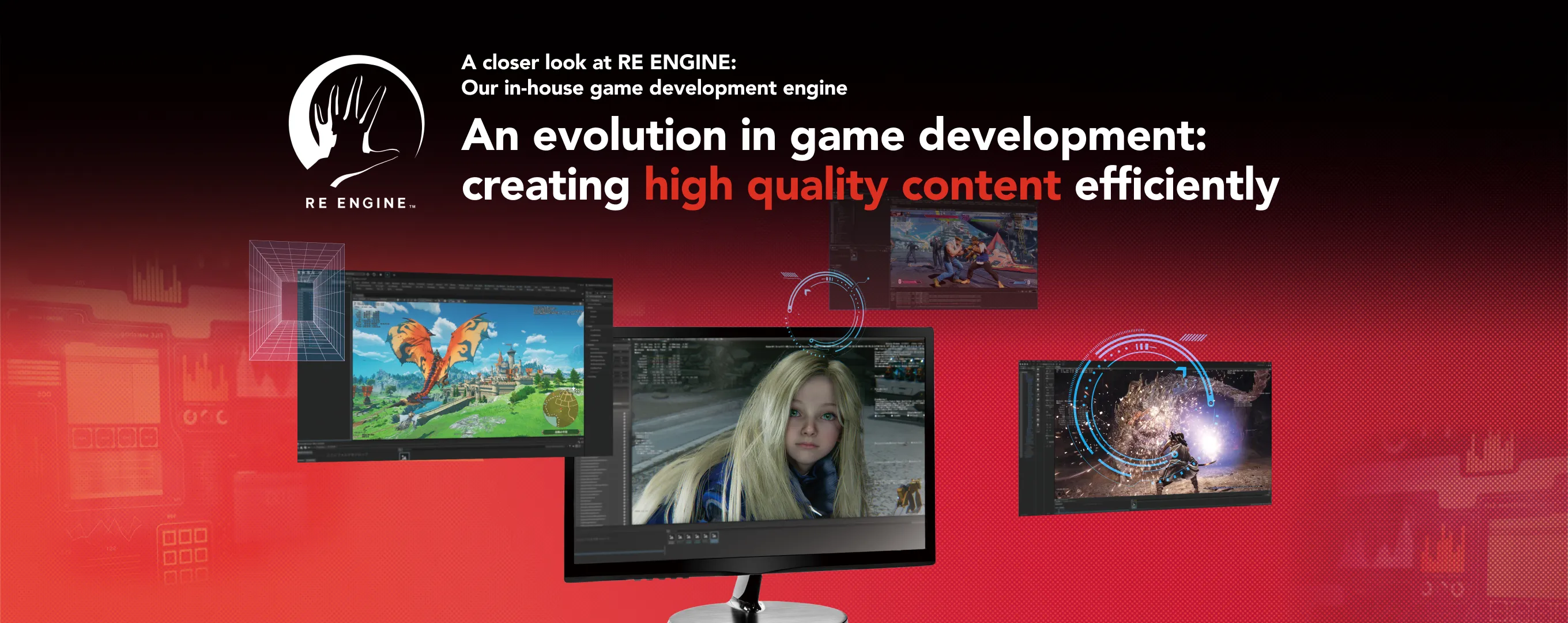

The culmination of Capcom’s craft
Development engine supporting all titles
RE ENGINE is best described as an in-house game development engine that supports multiple platforms and is perfectly suited for Capcom’s approach to crafting games. Today, we use this engine to create all of our titles. From photorealistic games like Resident Evil Requiem to anime-style games like Monster Hunter Stories 3: Twisted Reflection, this single engine handles everything. As the gaming industry is often dominated by development using commercially available game engines or dedicated engines for each title, Capcom is a rare breed. Because of RE ENGINE, we can quickly incorporate cutting-edge technology into our development, and we were able to release two games, Street Fighter 6 and Kunitsu-Gami: Path of the Goddess, as launch titles for the Nintendo Switch 2 , which debuted in June 2025. This is also the result of highly efficient development using RE ENGINE.
Engine-driven in-house production is an investment in our future
Behind Capcom’s move to in-house game engine development was a sense of urgency. About 20 years ago, new game consoles debuted one after another, causing the development process to become more complex and the workload to increase. We felt that if this continued, we would no longer be able to craft games that are uniquely Capcom. This led to the development of MT Framework, the predecessor to RE ENGINE. While MT Framework made it possible to efficiently develop high-quality games, the pace of innovation in IT was rapid and the global gaming environment was changing just as quickly. In order to further improve development efficiency and optimize the environment to accommodate content that was fast becoming larger and more complex, a new foundation for development was urgently needed. Therefore, in order to establish the development environment that creators desired during the development of Resident Evil 7 biohazard (released in 2017) the engine development team worked closely with the game development team to create the new RE ENGINE. The “RE” in RE ENGINE embodies our desire to “Reach for the Moon,” or the impossible, with this engine.
We will continue to invest in RE ENGINE to further strengthen Capcom’s quality in the future.
Finding the right solutions for Capcom’s game creation
The best part of RE ENGINE is that it was developed to suit Capcom’s game development workflow. Games in the genres of horror, fighting, and hunting can all be developed with this one engine. Everything from rendering to editing, playtesting, and quality control can be completed within RE ENGINE, greatly improving development efficiency. We have taken various measures to make the engine easier to use for development team members, such as enabling assets (images, 3D models, and other materials) once created to be shared across titles.
The R&D Foundational Technology Department, which is responsible for RE ENGINE, has a team of approximately 200 engineers, of which around 160 are in charge of engine development. However, their responsibilities go beyond expanding functions, interface improvement, and maintenance. Aiming to create an engine that makes it easier to develop advanced technology, they are also actively involved in title development. Engine development members are dispatched to each title to gather requests for necessary functions and customizations, which are then implemented after extensive discussions between both sides. This improves game functionality. Rather than discarding past technology, we allow it to coexist with new technology and adjust it to run on compatible platforms.
Furthermore, by developing all titles with RE ENGINE, we have also increased the mobility of our personnel. Even if members who have finished development are transferred to another team, they do not need to relearn the engine, and can immediately start developing a new game. Games are made by people, who are Capcom’s greatest asset. We believe that the benefits of in-house development can be seen in a variety of areas.
New engine development making the impossible possible
If RE ENGINE is the foundation for Capcom’s title development, then the engine should also be a “guidepost” that stays several steps ahead of title evolution. This is why we are currently developing the next generation of our engine, REX (RE neXt Engine). Rather than completely replacing RE ENGINE, we plan to evolve it step by step, integrating new technologies in line with trends in IT.
We are also incorporating external perspectives, such as those of professional engineers and students who participated in the Capcom Open Conference and Capcom Games Competition. The aim is to create specifications that make development easier for our in-house team. With a commitment to provide a more diverse gaming experience for the world, we are working to make the impossible possible. As the word “engine” implies, RE ENGINE will help drive us as we take on the world.
Students try their hand at development using RE ENGINE at the Capcom Games Competition
Capcom’s mission is to also nurture the next generation of game creators and energize the entire game industry. As part of this effort, in 2024, we partnered with Kindai University to hold a hands-on game development class using RE ENGINE. Expanding on this, in 2025, we will host the first Capcom Games Competition, a game creation competition for Japanese students. Participating student teams will develop games using RE ENGINE in a cloud environment. Each team will be supported by RE ENGINE staff as mentors. Students will learn about the latest game development techniques from professionals and Capcom will receive external feedback from students using the engine for the first time, which will be used to improve usability.

Graphics made possible by RE ENGINE
RE ENGINE is a multi-functional engine that not only improves development efficiency but also enables the expression and movement of high-quality graphics in real time. It is designed for stable operation in a variety of environments while incorporating new technologies to bring to life the elements and expressions required for each title.
Innovations in lighting
RE ENGINE supports a variety of lighting methods. These include “light probes*1,” which can be expressed with low processing costs, “ray tracing*2,” which calculates the path of light according to the required purpose such as shadows and reflections, and “path tracing*3,” which is an even more advanced version of ray tracing. RE ENGINE delivers optimal graphics for the platform and the spec of the hardware on which the player is playing.

Realistic horror with path tracing
Resident Evil Requiem uses path tracing for rendering that is much closer to the real world. By expressing multiple shadows generated by numerous fluctuating lights, players are left wondering, “What’s that over there?” This vivid depiction of light and darkness adds a new dimension to the horror genre.

Photorealism delivers a truly immersive experience
Improvements in rendering technology have made the texture of characters’ skin, eyes, clothing, and more increasingly realistic. In particular, hair is treated as an independent thread (“strand”) using a technology called “strand hair,” which allows each strand to sway naturally with the character’s facial expressions and movements. Combined with light transmission, players can enjoy the game as if they were controlling a live-action movie.

- Because they use pre-calculation, light probes do not have any problems in static spaces, but the quality drops when depicting dynamic objects or light sources.
- Ray tracing uses direct light from the camera’s viewpoint and some reflected light. Because calculations are performed in real time, quality can be guaranteed even in dynamic spaces, but processing costs are higher than with light probes.
- Path tracing statistically processes the path of light throughout the entire space, enabling the realistic depiction of complex indirect light, reflection, and refraction. However, path tracing requires a much larger amount of calculation than ray tracing.

Development Strategy
- The Head of Development Discusses Strategy
- Capcom’s world-renowned major IP
- Latest title in the Resident Evil series
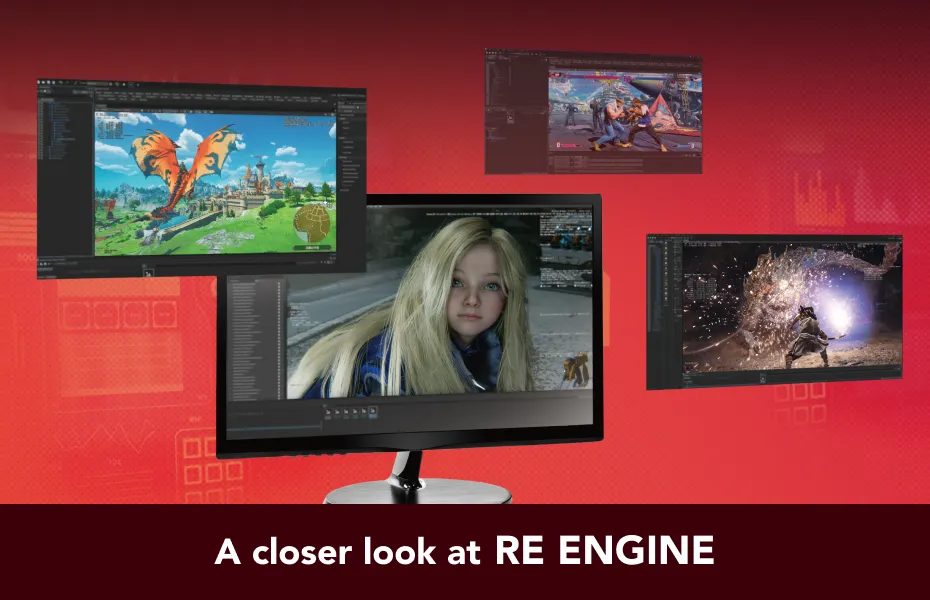
- A closer look at RE ENGINE