

- Value Creation Progress and Vision
- Value Creation Strategy
- Medium- to Long-Term
Growth Strategy - Development Strategy
- Sustainability
- Corporate
Governance - Financial Analysis
and Corporate Data
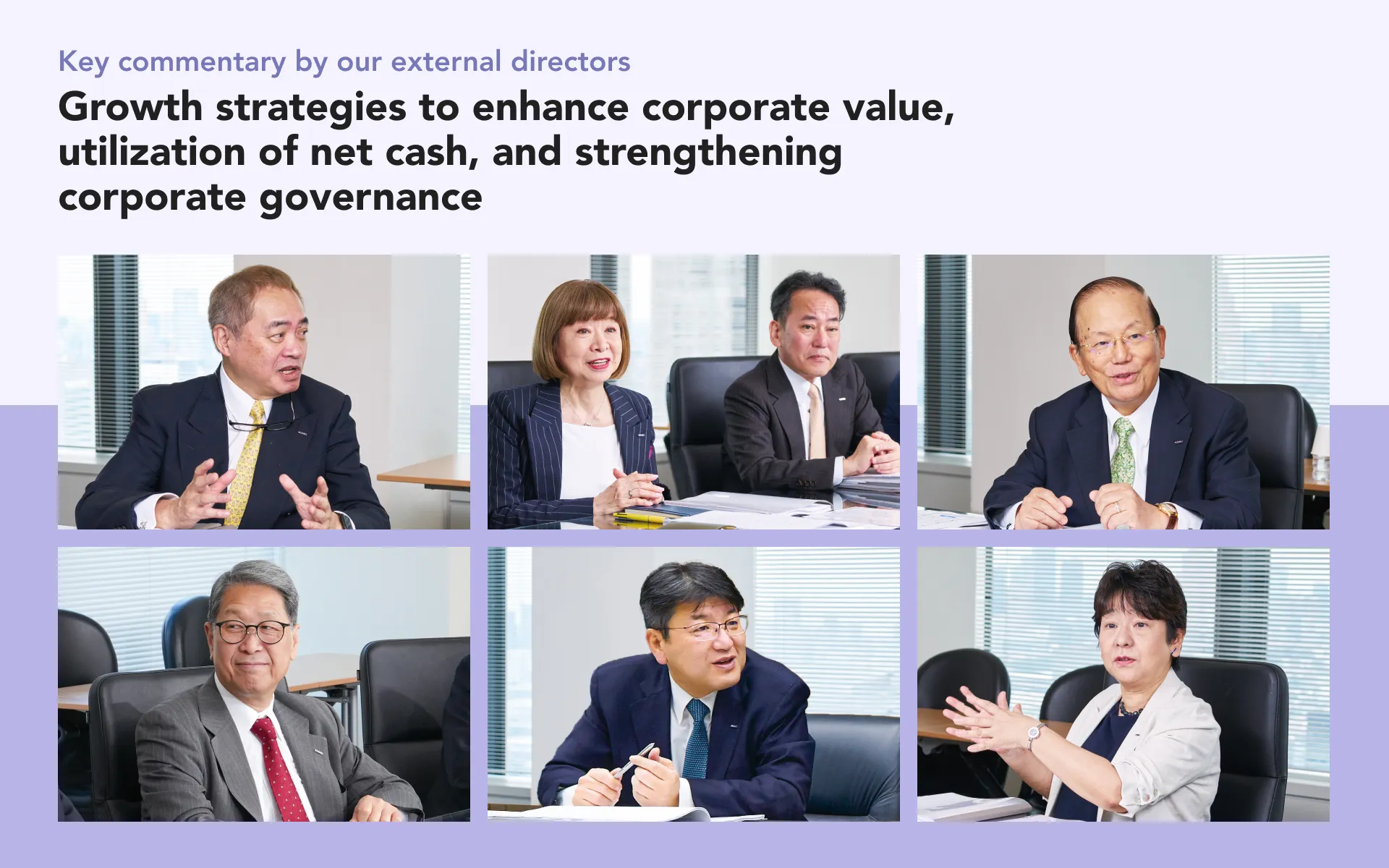
Capcom is striving to enhance medium- to long-term corporate value by strengthening its corporate governance functions.
In addition, we promote information sharing and mutual understanding by holding discussions at the Nomination and Remuneration Committee, led primarily by external directors, and organizing round table meetings for opinion exchange. Through active exchanges of views and advice, we are strengthening corporate governance by ensuring transparency and soundness.
As part of these efforts, this page introduces some of the comments shared by external directors at those meetings during the fiscal year ended March 31, 2025.




Sales strategy for achieving 100 million units
Capcom aims to reach 100 million units in annual sales of our titles in the medium-to-long term while we construct an organizational structure that allows us to propose measures that suit each country and region and work on strengthening sales in developing nations for our global sales network that distributes game content.
With digital sales now the norm, there may be a way to construct separate sales organizations for each title rather than for each country and region. In addition, we consider that it is vital to have local personnel who can survey sales trends and legal systems when opening up new areas.
Is progress being made in identifying the economic conditions, infrastructure status, and effective promotional methods in each region? It is essential to organize the challenges and clarify the sales strategies for formulating and implementing measures that will steadily lead to an increase in unit sales.
In expanding sales globally, it is important that an effective promotion system and environment have been established within the company as part of our ongoing surveys and understanding of local culture, rather than just considering the legal systems of each country and region or what languages to support. We believe that going beyond in-name-only responses to take a new look at the effectiveness of this system will lead to an increase in the number of units.
To further capture potential purchasing power, we will continue to analyze markets and so on, and implement a range of measures that include local surveys of the gaming culture and living standards in each region, as well as move towards establishing a sales organization that starts with the construction of systems for cooperating with local partners.
To support culturalization, we are strengthening recruitment in regions where we aim to grow unit sales, and we prioritize translation by native speakers who understand the cultural background while reinforcing our Localization Department. We will continue to formulate strategies tailored to regional characteristics.
For language support, we should estimate potential user numbers by language based on speaker populations in the future in addition to our actual sales basis.
In terms of strengthening our Media Business to increase unit sales, Capcom must work to grow through active market development that includes accurately understanding the media channels in each country and developing them using the most appropriate methods for each.
We will continue our research and enhance language support tailored to each game’s unique characteristics, while taking a holistic approach that considers language populations, support costs, and potential market needs in each country.
Utilization of net cash and investment measures
With net cash accumulating, we should take dividend decisions into account. It is vital to clearly communicate to investors our policy on shareholder returns including dividends.
Capcom currently maintains a high equity ratio and a strong level of capital efficiency; these figures are important indicators of management’s stance, and now that we have ample cash, it is crucial to deploy it proactively for future growth and to generate new profits, rather than simply accumulating it. Sustained earnings growth will remain essential to continue appropriate distributions that serve shareholders’ interests.
The Board of Directors should continue discussions on how to use net cash, with pillars that include shareholder returns centered on a 30% payout ratio, reinvestment in the business (such as further strengthening development and M&A), and returns to employees. From the standpoint of fulfilling external accountability, it is also crucial to clearly and carefully explain our cash management policy, its uses, and objectives to stakeholders.
We are deploying cash to invest in new areas of technology, personnel, and to develop and expand our development environment, including the new development building currently under construction. We will continue to invest in the business while closely monitoring cash utilization. In addition, to ensure stable profit distribution in line with our dividend policy, we will work to establish a business model capable of generating cash and consider future uses strategically.
Director remuneration system
Since the Corporate Governance Code was established, performance-linked executive remuneration has become the social norm, and we introduced a stock-based remuneration system in 2024. Performance-linked remuneration for executive directors should be reviewed annually, and adjustments or revisions should be made as needed to ensure appropriate incentives, with due regard to consistency with the core scheme discussed to date.
Revising the executive remuneration system to increase the performance-linked ratio has become a marked trend in recent years. At the same time, discussions tend to focus on executive directors in charge of business execution, with external directors and Audit and Supervisory Committee members at risk of being left behind. From the perspective that they all share the responsibility for the Company’s growth, we should continue to hold discussions on the shape of the remuneration system.
In revising the current remuneration system for executive directors, we reflected the views of key institutional investors obtained through SR meetings. On the other hand, recently, ideas regarding performance-linked remuneration or stock compensation have become an issue with respect to remuneration for external directors and members of the Audit and Supervisory Committee.
We will continue to scrutinize the current remuneration system while holding ongoing dialogues with institutional investors regarding how the remuneration system for directors should work, based sharing a common understanding of interests with shareholders.
Key commentary by our external directors
2. Election of Directors and Revision of the Remuneration System at the 2024 Ordinary General Meeting of Shareholders