Relationships with Customers and the Community
(*Edited from Integrated Report 2025)
Healthy Development of Entertainment
Compliance with the CERO rating system and endorsement of guidelines
The Computer Entertainment Rating Organization (CERO), a Specified Nonprofit Corporation, was created to provide age-appropriate ratings for video games. Capcom complies with the CERO rating system and rules.
The rating system is an initiative for the healthy development of young people that calls for voluntary restrictions on home video game content and sales methods to limit access by young people to sexual or violent content. In addition, recent game platforms include a parental control function that enables parents to limit the online purchase and use of certain games according to their ratings.
Furthermore, Capcom endorses the various guidelines established by the Computer Entertainment Supplier’s Association (CESA). We promote voluntary regulation and initiatives for sound operations to ensure our users can enjoy games with peace of mind.
Addressing the WHO’s recognition of gaming disorder
In 2019, the World Health Organization (WHO) included gaming disorder as a new mental health condition characterized by excessive use of games to the point where it has a negative impact on health and social life. In March 2025, the Gaming Disorder Research Study Group released the Gaming Disorder Cross-Sectional Survey Report based on findings published in 2023 and commissioned by industry organizations in response to social demand. We are taking the appropriate steps to raise awareness of the issue and are cooperating with industry organizations that promote further detailed analysis and discussions based on published papers.
Addressing addiction to pachinko and pachislo
Pachinko and pachislo are a form of entertainment that has taken root in society. At the same time, however, there is concern over players becoming addicted.
In 2017, the Pachinko and Pachislo Industry Association for the 21st Century, which consists of 13 organizations from the amusement industry, announced the Declaration on Pachinko and Pachislo Addiction, strengthening measures such as the regular disclosure of the Pachinko/Pachislo Addiction Countermeasures Implementation Status Report. Capcom endorses and cooperates with these initiatives to contribute to healthy development of the industry.
The Recovery Support Network (RSN), a pachinko addiction consultation hotline supported by industry organizations, provides free telephone consultations and displays posters at all pachinko hall locations nationwide to raise awareness of addiction among players and employees, establishing a system in which pachinko and pachislo advisors (specialist staff) are stationed at each location to provide customers with appropriate information on addiction, and preparing guidelines for addressing addiction at pachinko parlors. Additionally, we include warnings about overindulgence in posters and brochures used in our product promotion activities.
Considerations in Game Development
In-game purchases
In the Japanese game market, discussions have been taking place for some time on the problem of gacha, or high-priced lottery-style game mechanics, primarily in mobile games. Overseas, gacha-like "loot boxes" have been banned in some countries.
As a creator of entertainment culture, Capcom believes that games should be enjoyed for the entertainment value they provide with gameplay, not for thrills associated with winning a lottery. We do not want to see games that are supposed to make people happy having the opposite effect as a result of excessive charges. For that reason, we are working to ensure that all users can enjoy our games fairly and safely. In principle, we minimize gacha elements in the mobile games we develop; in our home video games, we provide any content required to enjoy the full game free of charge, while offering some additional content at low cost.
Localization and culturalization
Capcom games are enjoyed worldwide. In the fiscal year ended March 2025, the percentage of home video games sold overseas was 83.8%. Naturally, translation (localization) of video games developed in Japanese is required so that game players around the world can enjoy them. The volume and importance of localization is increasing year after year due to factors such as improvements in game machine performance, support for online gameplay, and an increase in the number of languages accompanying a more diversified, global audience. As such, Capcom’s localization team is involved in game development from the initial stages.
By carrying out localization concurrently with development, rather than following completion of the Japanese language version as had been done in the past, Capcom is able to launch games simultaneously around the globe. What is more, depending on the country, simply translating games developed under Japanese norms can end up hurting users unexpectedly due to historical, religious, or cultural differences.
As such, we focus on employing staff from around the world to culturize the games so that they can be enjoyed by all, regardless of locale.
The Journey of Educational Support Activities Bridging Games and Education
More than 15 years of on-site classes for children in school
Games are a relatively new cultural phenomenon with little academic research, and discussions tend to focus on the detrimental effects rather than the educational aspects. However, the job of video game creator has been a popular future career choice among children for many years.
Given this, with a desire to promote social understanding of games, we accept visits to our offices from primarily elementary and junior high school students and conduct on-site classes at schools to help promote sustainable economic growth and social development. Class programs have three sessions: Career Education, Game Literacy Education, and Capcom: Work × Mathematics.
Altogether, Capcom has welcomed 3,546 children as part of 414 different field trips to its offices (as of March 31, 2025). Capcom has also held 260 on-site classes for 20,237 students (as of March 31, 2025).

Enhancing Customer Support
User support and utilizing feedback
At Capcom, we have dedicated support teams for each product to ensure that customers can fully enjoy the services they purchase. We also strive to quickly respond to customer questions by providing FAQs on the Capcom Customer Support Center website, while each person in charge regularly engages in information exchanges with other teams, working to improve customer satisfaction. The questions and feedback our game support teams receive are condensed and analyzed to be incorporated in development of new products.
Additionally, we have formulated and disclosed our Customer Harassment Response Guidelines based on the Ministry of Health, Labour and Welfare’s Customer Harassment Countermeasures Company Manual.
Providing an Entertaining Experience for All Ages
Opening interactive amusement facilities for families
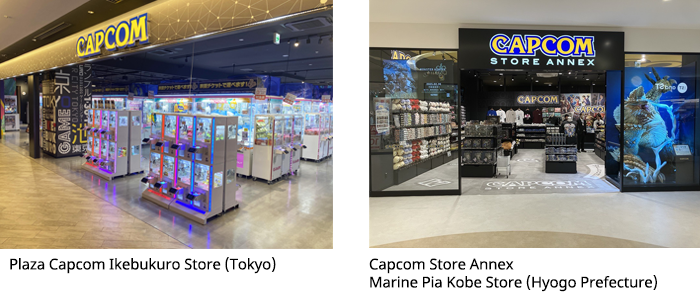
Recently, amusement facilities have gained popularity as places for seniors to socialize with friends and staff, and as experiential venues for families. Capcom aims to create stores where a wide range of customers can enjoy themselves with peace of mind. This is achieved by having staff certified as service assistants provide customer service and support, ensuring a comfortable environment for senior patrons, and by developing stores equipped with children’s play equipment.
Furthermore, in recent years, responding to the recovery of inbound demand and out-of-home consumption following the COVID-19 pandemic, as well as changes in consumer behavior, we are also advancing new business formats such as retail stores selling popular character goods and capsule toy specialty shops.
Support for Social Welfare and the Promotion of Regional, Cultural, Technological, and Sports Initiatives
Support for youth development and disaster-affected areas
The Capcom Group focuses on supporting children who will shape the future through activities such as donations. During the fiscal year ended March 2025, we continued donations to organizations dedicated to the healthy development of youth, including Save the Children Japan (public interest incorporated association). We also entrusted funds to related organizations for disaster recovery efforts following earthquakes and other disasters, as well as for global refugee support.
Supporting development and promotion as an osaka-based entertainment company
The Capcom Group, under the slogan "From Osaka, to the World," is committed to promoting regional, cultural, technological, and competitive athletic development. We contribute to the advancement of local communities and sports through initiatives such as exhibiting Monster Hunter Bridge at the Osaka Healthcare Pavilion during the Expo 2025 Osaka, Kansai, Japan, the marketing partner deal with the Japan Volleyball Association, and our top partner agreement with Cerezo Osaka Co., Ltd.
Expanding gaming opportunities through esports
Capcom views esports as a new-era sport where anyone can compete regardless of age, gender, or physical ability. Since 2014, we have hosted tournaments utilizing the Street Fighter series across up to 160 countries and regions. In fiscal year 2024, we held finals and other events at the Ryogoku Kokugikan Arena, achieving great success. Furthermore, we have decided on a three-year partnership with the Esports World Cup, an esports event held in Saudi Arabia starting in fiscal year 2025. We will continue to contribute not only to the global revitalization of the esports market but also to its further spread within Japan.
Contributions to Regional Revitalization
Empowering local governments using popular game brand recognition
Capcom has been engaged in the following four regional revitalization activities across Japan: 1) supporting local tourism; 2) enhancing education on local history and culture; 3) working with police on crime prevention education; and 4) encouraging voter participation with election committees. Via a partnership agreement with Kashihara City, Nara Prefecture, bronze statues of Street Fighter characters have been installed throughout the city.