Corporate Governance Structure and Initiatives | Directors
The Capcom Group is committed to leveraging its strengths per our Management Philosophy to achieve stable medium- to long-term growth and enhance corporate value through our business activities. To accomplish this, we are focused on increasing management transparency and soundness, building a system that can adapt to environmental changes, and continuously improving our corporate governance.
In this section, Capcom will explain the corporate governance structure and systems that it has initiated so far based on the key concepts of “effectiveness and visibility” in terms of the results of third-party assessment.
-
Capcom Corporate Governance Guidelines (July 29, 2026)
PDF
-
Corporate Governance Report (July 29, 2026)
PDF
External Directors
Using external perspectives to ensure effective governance
External directors ensure the effectiveness of the corporate governance function by playing key roles in the Nomination and Remuneration Committee and the Compliance Committee.
They also focus efforts on compliance and the prevention of corrupt or illegal activities, and openly exchange opinions and provide counsel at Board of Directors meetings in an effort to strengthen the management audit function. The Secretariat staff helps with the work of the external directors who are not members of the Audit and Supervisory Committee. For external directors who are members of the Audit and Supervisory Committee, the full-time staff of the Internal Audit Division helps with their work.
Since all seven of the external directors meet the criteria of independent directors, they have been notified to Tokyo Stock Exchange, Inc. as independent directors. In addition, the Company has established Criteria for Independence of External Directors, and considers individuals who do not conflict with these standards to be independent external directors.
For the "Criteria for Independence of External Directors," please refer to the " Notice of Convocation of the 2025 Annual General Meeting of Shareholders " available on the "General Meeting of Shareholders"
Reasons for Selection of External Directors
| Name | Reasons for selection |
|---|---|
| External Directors | |
| Yutaka Mizukoshi |
Due to expectations for his ability to contribute to the auditing and supervision of the Board of Directors based on an external perspective, including his enthusiastic provision of opinions and advice from an independent standpoint based on his familiarity with management analysis and establishment of management strategies as well as his deep insight into economic trends and international sensibilities that comes from his experience and knowledge from his many years in the consulting industry. |
| Toshiro Muto |
Due to expectations for his ability to contribute to the auditing and supervision of the Board of Directors by providing objective opinions and advice on general management from an independent standpoint with a broad perspective based on his extensive knowledge and experience as he possesses a high level of insight related to fiscal and monetary affairs, general economics, and corporate governance cultivated at the Ministry of Finance, the Bank of Japan, and operating companies. |
| Yumi Hirose |
Due to expectations for her ability to contribute to the auditing and supervision of the Board of Directors and improvement of the human resources strategy by actively providing opinions and advice from an outside perspective based on her knowledge and experience, which include specialized knowledge and extensive experience from her many years as a tax administrator of tax agency offices, her considerable knowledge of finance and accounting, and her high level of knowledge related to health management. |
| Main Kohda |
In addition to possessing extensive insights into international finance, her experience serving as a member of various governmental advisory councils and her rich background as an external director for publicly listed companies have given her a deep understanding of the business world, allowing her to actively offer opinions and proposals from an independent and impartial standpoint. Given her wealth of knowledge, experience, and the profound insights and objective perspective demonstrated through her writing activities, she is expected to contribute to enhancing the Board of Directors’ auditing and supervision. |
| Yasuko Metcalf |
As a U.S. Certified Public Accountant (USCPA), she possesses extensive expertise in international corporate management and governance, along with substantial knowledge in finance and accounting, gained from years of experience in auditing, tax, and consulting at U.S. audit firms. Her rich expertise, experience, and global perspective are expected to contribute to enhancing the Board of Directors’ auditing and supervision. |
| External Directors (Audit and Supervisory Committee) | |
| Mutsuhiko Koro |
In addition to his specialized knowledge and extensive experience in tax administration, he possesses considerable expertise in finance and accounting. Thus, based on this high level of insight, he provides advice and counsel from an external perspective. He is expected to contribute to enhancing the Board of Directors’ auditing and supervision from an independent and objective standpoint. |
| Wataru Kotani |
Due to expectations for his ability to contribute to the auditing and supervision of the Board of Directors based on the perspective of risk management and legal compliance, as he possesses broad expertise and extensive experience in IT security and legal affairs from his many years of involvement in police administration and provides opinions and advice from a neutral and objective standpoint. |
Evaluation of the Effectiveness of the Board of Directors
The Company evaluates the effectiveness of the Board of Directors by means of individual questionnaires, interviews, and other methods that facilitate getting individual opinions from all directors. The evaluation for the fiscal year ended March 31, 2025, using such criteria as the following initiatives, was generally positive, confirming that the Board of Directors is functionally effectively.
- ・Considering the remuneration system for directors and executive officers as a way improve corporate value over the medium to long term
- ・Promoting mutual understanding among directors through continuing to hold meetings to exchange opinions with outside directors and other measures
In the fiscal year ending March 31, 2026, the following issues will continue to be focused on.
- ・Deepening discussions on medium- to long-term key issues and strategies within the Board of Directors
- ・Enhancing the company-wide risk management framework and strengthening oversight by the Board of Directors
Capcom’s Board of Directors will continue to strive to improve its effectiveness in light of the results of this evaluation.
Officer Remuneration
Revised Remuneration System Aimed at Enhancing Corporate Value and Alignment with Shareholders
The Company reviewed the remuneration system for Directors (excluding External Directors and Members of the Audit and Supervisory Committee. Hereinafter "Eligible Directors") at the General Meeting of Shareholders held in June 2024 with the aim of further strengthening efforts to increase the Company’s corporate value over the medium- to long-term, granting incentives to help the Group achieve stable profit growth, and sharing value with shareholders.
(1) Revision of Monetary Compensation Framework
Establishment of a performance-based bonus separate from base compensation, which varies in accordance with the Group’s business performance growth and other factors
(2) Introduction of Stock Compensation System
Introduction of a performance-linked stock compensation system that uses the achievement level of growth targets of business performance among other factors as a benchmark
Guidelines for Determining the Remuneration, etc. of Individual Directors
1. Determination Guidelines for Remuneration, etc. of Directors (excluding members of the Audit and Supervisory Committee)
In order to ensure objectivity and transparency regarding remuneration for Directors (excluding members of the Audit and Supervisory Committee), the Board of Directors consults the Nomination and Remuneration Committee, which is chaired by an External Director (with External Directors comprising the majority of its members), and determines remuneration within the remuneration limit resolved at the General Meeting of Shareholders based on the deliberation and recommendations of the Committee regarding the following guidelines.
(1) Remuneration, etc. for Directors (excluding External Directors and members of the Audit and Supervisory Committee) is composed of basic remuneration (fixed remuneration) to encourage steady performance of duties commensurate with positions, responsibilities, etc., as well as performance-linked remuneration (variable remuneration) which consists of short-term incentives such as bonuses and medium- to long-term incentives such as stock remuneration, as a remuneration system and composition that is highly linked to business performance and focuses on increasing corporate value and shareholder value over the medium- to long-term.
(2) In view of their role of supervising the management of the Company from an objective and independent standpoint, remuneration for External Directors (excluding members of the Audit and Supervisory Committee) is not linked to business performance, and consists only of basic remuneration (fixed remuneration).
2. Determination Guidelines for Remuneration, etc. of Directors who are members of the Audit and Supervisory Committee In order to ensure independence, individual remuneration, etc. for Directors who are members of the Audit and Supervisory Committee is not linked to business performance, and consists only of basic remuneration (fixed remuneration). The amount is determined within the total amount approved at the General Meeting of Shareholders through consultation among Directors who are members of the Audit and Supervisory Committee, taking into account full-time and part-time positions.
See the [Reports and Materials] Annual Securities Report for details on the director remuneration. (Japanese language only)
Remuneration system for Eligible Directors
Scroll horizontally to view

| Type of remuneration | Overview | |||
|---|---|---|---|---|
| Fixed remuneration |
Monetary | Basic remuneration |
|
|
| Performance-linked remuneration (variable remuneration) | Short-term | Monetary | Bonuses |
|
| Medium-to long-term | Stock | Performance- linked stock remuneration |
|
|
-
(Notes)
1. TSR: Abbreviation for Total Shareholder Return. Total investment return for shareholders, including capital gains and dividends. Hereinafter referred to as "TSR."
2. Performance-linked remuneration (variable remuneration) will not be paid or will be returned in the following cases.
(a) The right to receive remuneration will be lost if the relevant parties engage in specific misconduct as determined by the Company’s Board of Directors, or resign from office due to specific reasons determined by the Company’s Board of Directors.
(b) As determined by the Company’s Board of Directors based on the results of deliberation and recommendations by the Nomination and Remuneration Committee, relevant parties may be asked to return all, or part of the remuneration received if financial statements were adjusted due to serious misconduct, fraud, or a serious accounting error.
Calculation Method for Performance-linked Remuneration
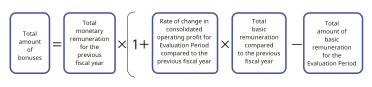
(1) Bonuses
[Calculation formula]
-
(Notes)
1. The Evaluation Period is one fiscal year, running from April 1 of each year to March 31 of the following year.
2. The calculation formula has been changed as above, effective for bonuses covering the Evaluation Period from April 1, 2025 to March 31, 2026.
(2) Performance-linked stock remuneration
[Calculation formula]
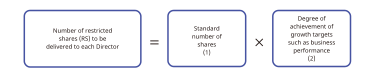
1) "Standard number of shares" is the number of shares calculated using the following formula.
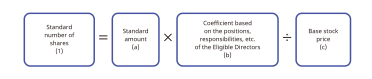
- (a) "Standard amount" is 50% of the total basic remuneration of Eligible Directors.
- (b) "Coefficient based on the positions, responsibilities, etc. of the Eligible Directors" is determined by the Company’s Board of Directors according to the positions, responsibilities, etc. of the Eligible Directors.
- (c) "Base stock price" is the average closing price of Company common shares on the Tokyo Stock Exchange for the month preceding the start of the Target Evaluation Period (Note).
-
(Note) The Target Evaluation Period will be three consecutive fiscal years from April 1 of each year to March 31 three years later.
2) "Degree of achievement of growth targets such as business performance" is an evaluation coefficient that varies from 0% to 150%, and is calculated according to (i) the degree of achievement of the growth target for net income attributable to owners of the parent and (ii) Company stock growth rate results of a relative comparison of the Company’s TSR with the Tokyo Stock Price Index (TOPIX)’s TSR during the Target Evaluation Period.
Scroll horizontally to view
| Evaluation indicator |
Evaluation percentage (weight) |
Evaluation coefficient fluctuation range |
Evaluation method |
|---|---|---|---|
| (i) net profit attributable to owners of the parent |
50% | 0% – 150% | Compare to the cumulative amount if 10% growth is achieved each fiscal year during the Target Evaluation Period, and if the degree of achievement is 41% or more, the evaluation coefficient will be in the range of 50% to 150%. |
| (ii) TSR (TOPIX comparison) |
50% | 0% – 150% | Compare the Company’s TSR during the Target Evaluation Period with the TOPIX growth rate for the same period, and if the growth rate is 50% or more, the evaluation coefficient will be in the range of 50% to 150%. |
| Total | 100% | 0% – 150% | – |
Remuneration Composition
The ratio of base remuneration, bonuses, and performance-linked stock remuneration for Eligible Directors is not set because the composition ratio changes depending on business performance and other factors. However, it is the Company’s policy that an appropriate remuneration system and structure should be in place to continuously improve business performance and corporate value over the medium- to long-term and to align profit interests with shareholders.
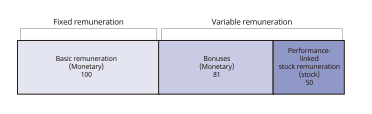
Reference: Image of Remuneration Composition for Eligible Directors
(Year ending March 31, 2026)
Amount of payment for bonuses and standard amount for the performance-linked stock compensation system when the management objective of 10% growth in consolidated operating income is achieved
(percentage in the case that basic remuneration is 100)
-
(Note) The above diagram is an illustration of the remuneration of Eligible Directors for the fiscal year ending March 31, 2026, calculated based on certain company performances and the unit price of Company shares. The above percentages will vary depending on the Company’s performance and changes in the stock price of Company shares.
Officer Remuneration (Year ended March 31, 2025)
Total remuneration, total amount by type of remuneration, and number of directors the remuneration was paid to, by type of director of delivery company
Scroll horizontally to view
| Type of director | Total remuneration (million yen) |
Total of remuneration by type (million yen) | Number of Basic directors paid |
|||
|---|---|---|---|---|---|---|
| Basic remuneration |
Bonus | Performance- linked stock remuneration |
Severance | |||
| Director (excluding Audit and Supervisory Committee and external directors) |
1,271 | 745 | 371 | 155 | – | 7 |
| Member of Audit and Supervisory Committee (excluding external directors) |
23 | 23 | – | – | – | 1 |
| External directors | 61 | 61 | – | – | – | 6 |
| Member of Audit and Supervisory Committee (external directors) |
36 | 36 | – | – | – | 4 |
-
(Note) Performance-linked stock remuneration is an expense recorded for the fiscal year ended March 2025. For compensation for the evaluation period from April 1, 2024, to March 31, 2027, certain estimates or assumptions are made about how much each indicator has been achieved, and the amount is calculated by setting the achievement rate of performance growth targets at 1.25 and dividing that amount by the three-year evaluation period.