- Value Creation Progress and Vision
- Value Creation Strategy
- Medium- to Long-Term
Growth Strategy - Development Strategy
- Sustainability
- Corporate
Governance - Financial Analysis
and Corporate Data
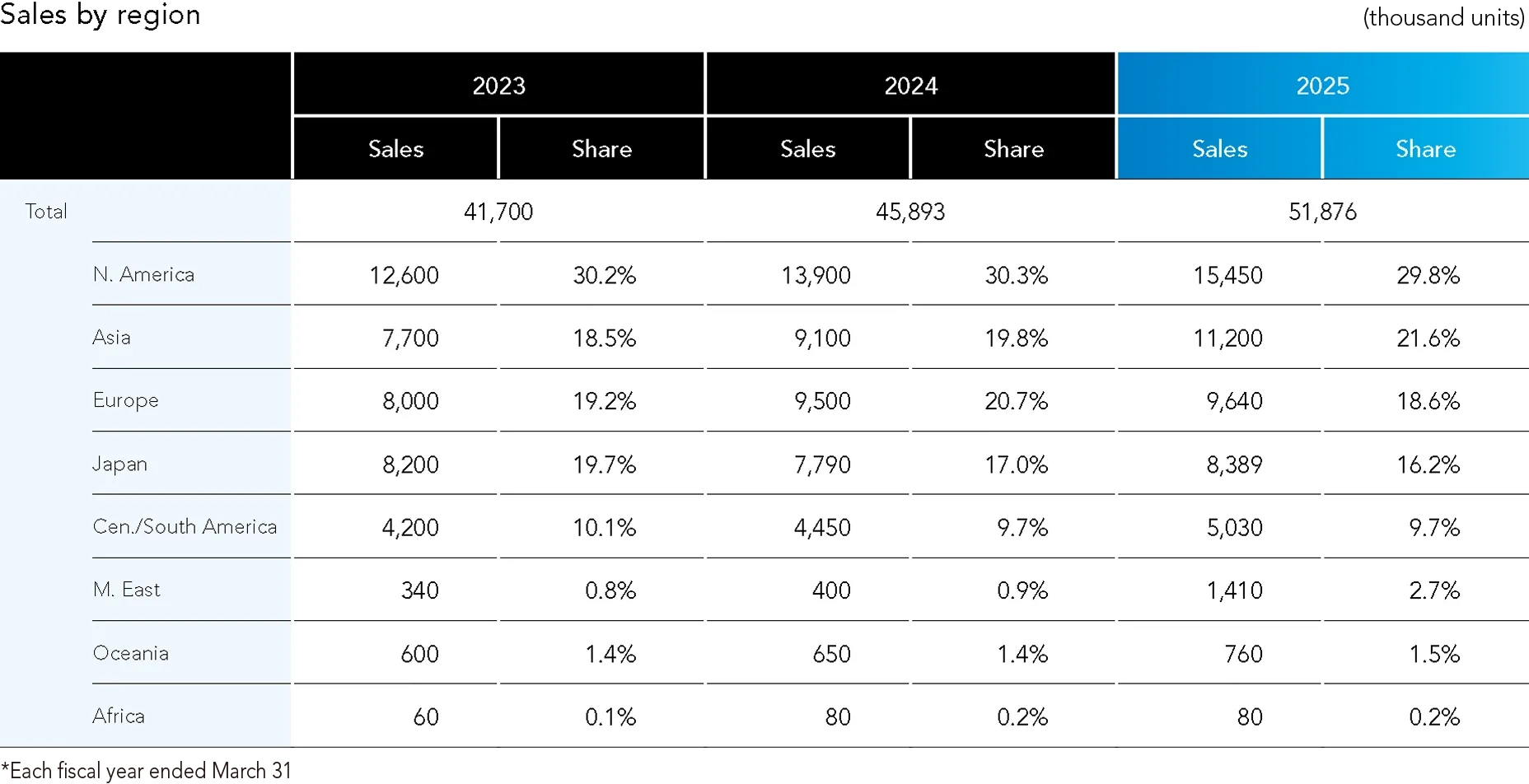
As of the fiscal year ended March 31, 2025, the Capcom Group achieved our 12th consecutive year of increased operating profit and 10th consecutive year of double-digit operating profit growth. Our sales volume also reached a record high of 51.87 million units. This has positioned us for a strong start heading into the next 10 years. I would like to express my sincere gratitude to all our stakeholders for their support.
Since the mid-2010s, Capcom has focused on our Digital Strategy with the aim of expanding globally and establishing stable revenue streams. In the past, traditional sales of physical discs presented numerous challenges, including limits to the amount of retail shelf-space we could secure, control over pricing, and anti-piracy measures. However, the shift to digital sales has enabled us to expand into over 220 countries and regions, with a revenue structure that is not reliant on new releases but rather has been centered on catalog title sales. To achieve sustainable growth, it is essential that we strengthen not only our development capabilities but also our sales and marketing systems. By consistently producing world-class content and increasing brand recognition, we are now one step closer to achieving our long-term goal of annual software sales of 100 million units. This initiative is in line with our corporate philosophy, which is that we are “creator of entertainment culture that excite people and stimulates their senses.”
Our Measures Thus Far
– Grow markets globally with digitalization –
Changing market landscape
In the era when disc sales were the mainstream, the major developed countries in Europe and North America were the focal point of the game market, where game content was mainly enjoyed on dedicated home consoles. Afterwards, the evolution of game consoles and the spread of the Internet have made it possible to play online and cooperatively with others over long distances, as well as to sell game content digitally through downloads. As a result, game content can be sold over the long term even if it has been on the market for many years, without being affected by retail store operating hours or sales floor space. This has also made it possible for game publishers to take the initiative in developing flexible pricing policies.
Strengthening our multi-platform strategy and tapping into demand from PC platforms
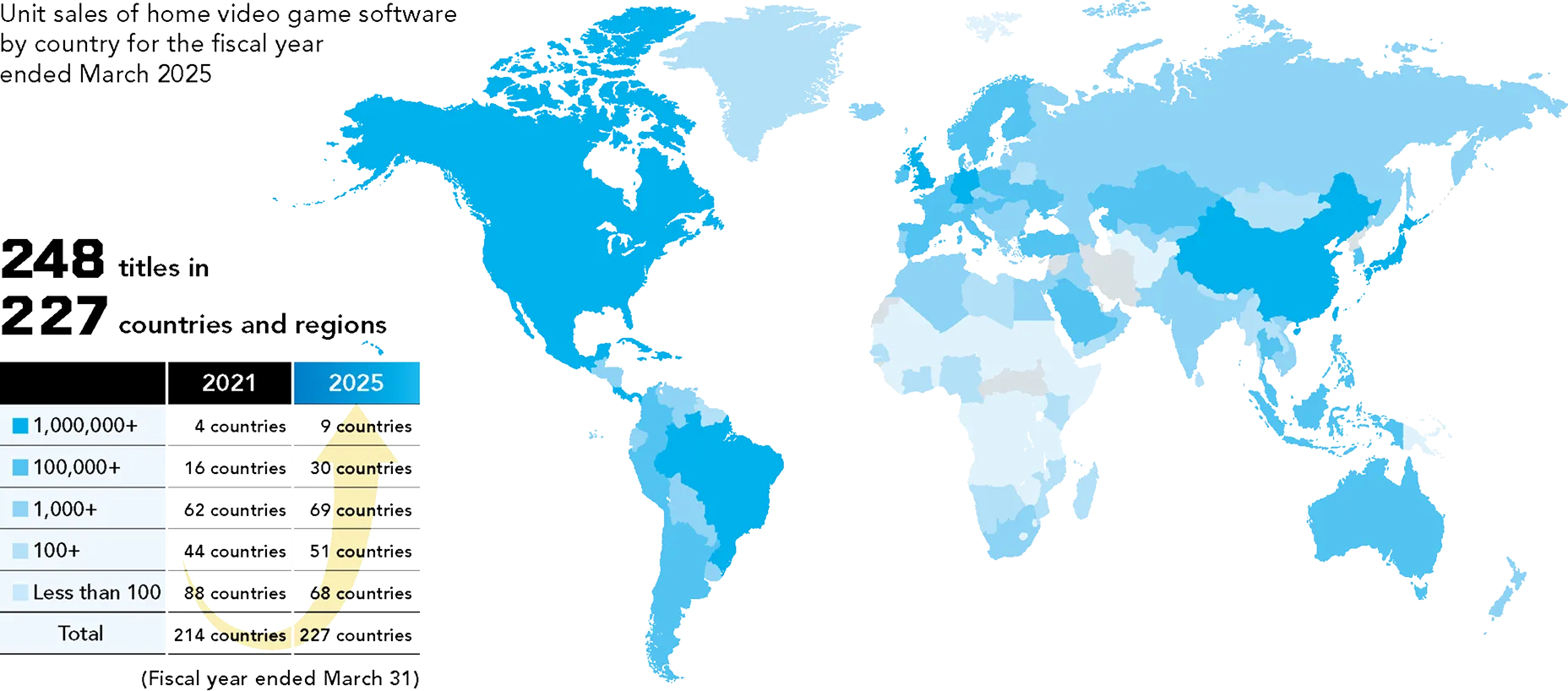
Within our Digital Strategy, we have also focused on expanding our support for the PC platform. Since development for dedicated game consoles tends to be limited to major developed countries with well-established infrastructure, we have determined that in order to reach more users, we must actively release content on the PC platform, which allows us to also appeal to developing and emerging markets. By focusing on the PC, we now sell our products in over 220 countries and regions, far exceeding the market for traditional consoles. Currently, the ratio of PC units in our software sales is growing, primarily in emerging countries, reaching a level of over 50% in the fiscal year ended March 31, 2025. Yet, we analyze that there is still room for further growth.
Recently, in appealing to different user demographics in each region, and the various platforms therein, including PC, we have seen that the level of quality being demanded is increasing as technology evolves, and have once again been reminded of the challenge of consistently providing a high-quality entertainment experience to a wide breadth of users.
Within such circumstances, we have strived to listen to the voices of our users and emphasized content creation that reflects their needs. Going forward, we will further strengthen our approach and continue working to provide a higher-quality and more consistent gaming experience for more users, while also strengthening our entire organization, including reviewing our development system.
Data-driven pricing strategy
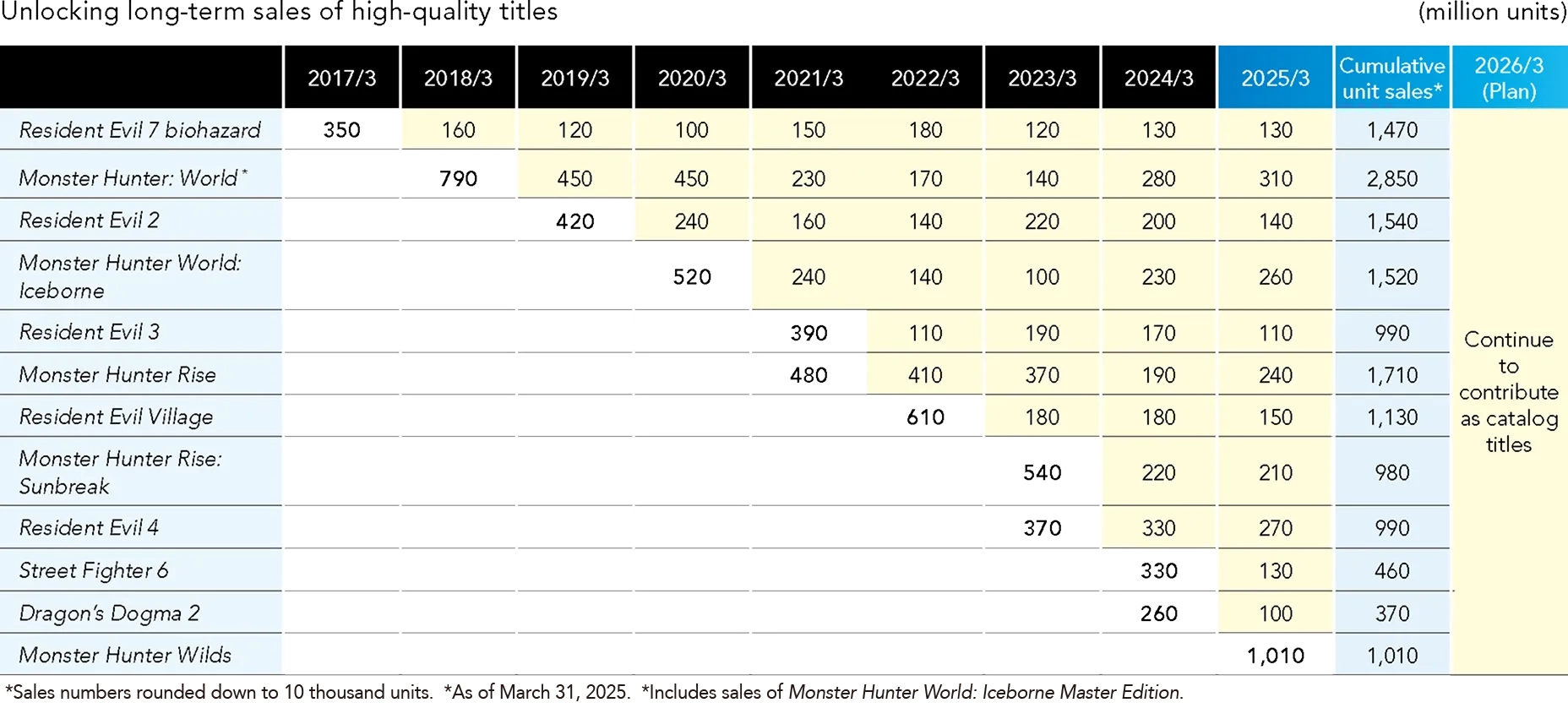
The digitalization of game sales has made it possible for publishers to lead the way in pricing strategies. We transitioned to digital sales early on and have accumulated extensive data, including by country, price, and sales volume. We have aggregated this data and are now utilizing it in our marketing strategies. Our basic pricing strategy is to sell games for approximately 60 to 70 US dollars when new, and then gradually lower the price according to market value, ultimately down to 10 or even 5 US dollars. The goal is to maximize sales and profits over a five-year period, rather than a single fiscal year. We are typically able to recover development costs within a period of one to two years, contributing to the bottom line even after price reductions. Furthermore, by coordinating price reductions with new title announcements, we can attract new fans and create a virtuous cycle linked to the next title release. A good example is Monster Hunter World We lowered the price to 9.99 US dollars in conjunction with the announcement of Monster Hunter Wilds in the fiscal year ended March 31, 2024. To date, Monster Hunter World has sold more than 28 million units.*
* Including Monster Hunter World: Iceborne Master Edition
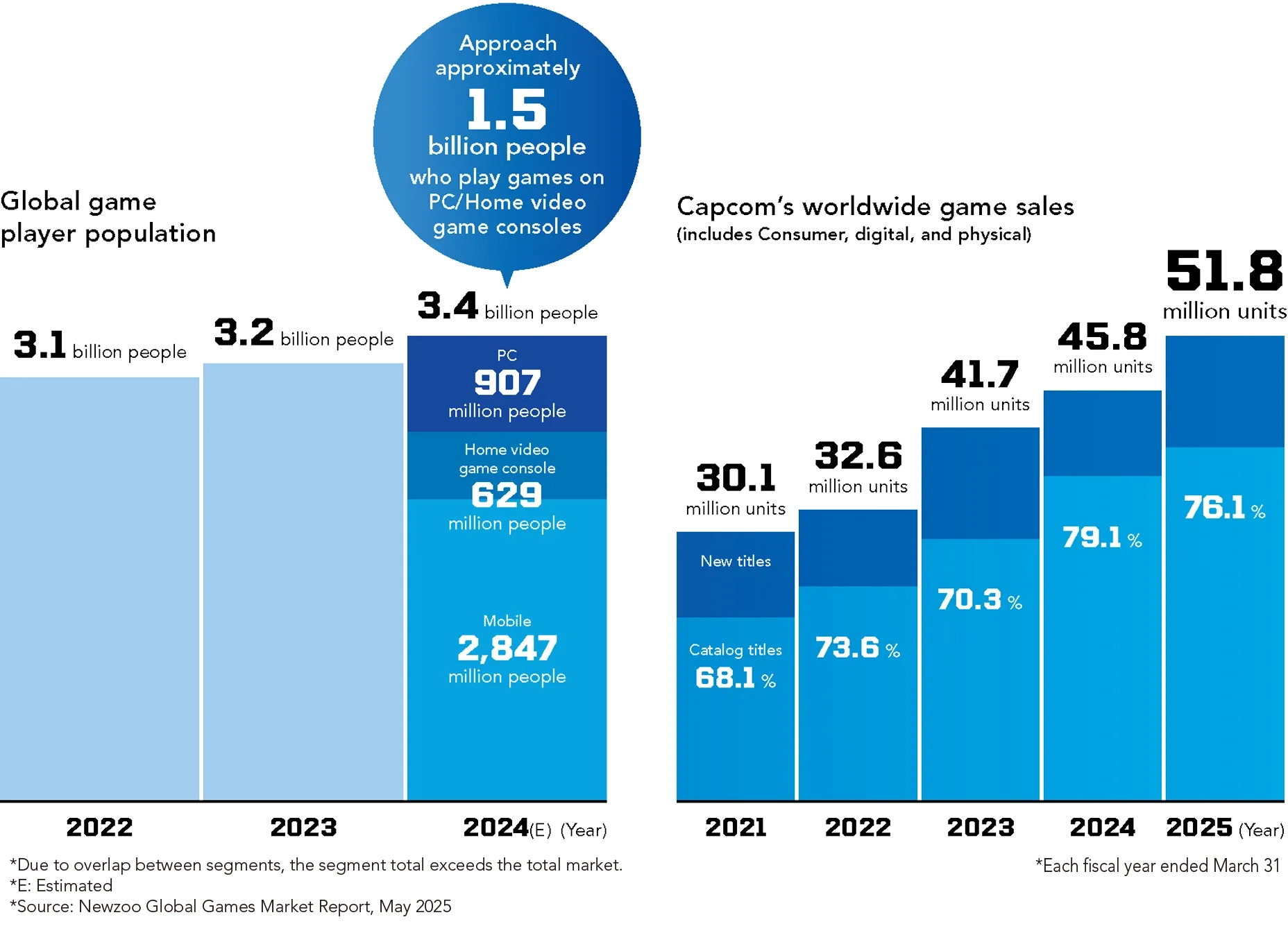
By selling high-quality titles over a long period of time, catalog titles have come to account for more than 70% of our annual unit sales, making a significant contribution to earnings in our Digital Contents business. This was a major factor in Capcom’s ability to establish a stable profit structure over the last 10 years.
Comparing our sales territory now with 2020, there are countries and regions where annual sales are gradually shifting from less than 100 units annually to more than 100, more than 1,000 more than 100,000, and even more than 1 million units. Indicative of this, as income levels rise due to economic growth in each country and region, we are seeing greater growth of our markets.
Needless to say, there are two factors behind the growth that makes it possible to sell globally over the long term: (1) From the time the company was established with our main business being arcade game circuit boards, Capcom had already started expanding throughout the world, giving us a brand status, and (2) due to the efforts of our development team, Capcom has the technical and developmental abilities to regularly produce high-quality titles.
Maximizing initial sales of new titles
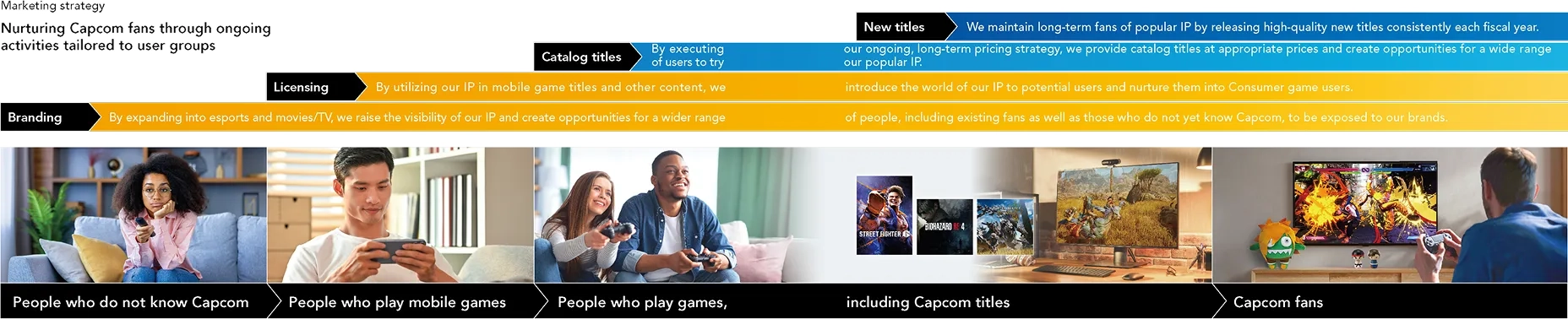
To what extent we increase initial sales will be important in unlocking greater growth. Analysis of sales trends for catalog titles has revealed that the stronger the initial sales, the more robust long-term sales can be, contributing to increased cumulative sales overall. Going forward, we will clearly focus on strengthening initial sales and step up our efforts to improve brand recognition. This will include expanding pre-release promotions and offering past titles globally. Through these measures, we aim to further improve sales performance.
Looking at the Next 10 Years
– Accelerate sustainable growth with better marketing –
I would like to explain specifically from my perspective as COO the key policies for the next decade as discussed by the CEO.
According to third-party market data, there are approximately 3.4 billion game users worldwide, most of whom are mobile device users. The number of PC and home console users, which are our primary target, is estimated to be around 1.5 billion.
Our software sales volume for the fiscal year ended March 31, 2025 was 51.87 million units. Thus, we believe there is still significant room for growth given the size of the market. To achieve annual sales of 100 million units, it is essential to further expand sales and strengthen our development system to enhance our pipeline of new titles. In addition, we will work to increase brand awareness through enhanced pre-release promotions and other measures to boost initial sales of new titles.
Improved marketing by incorporating local characteristics
We have been using our aggregated sales data in our marketing strategy, but we need to improve the accuracy of this approach. By targeting users with information on our latest titles or updates on catalog title prices based on their purchase trends, it will be possible to conduct promotions that appeal to users even more. However, it is not easy to accumulate detailed data linked to individuals. In addition, the laws and regulations of each country regarding the protection of personal information and the protection of minors must be carefully observed.
In this context, we will continue to accumulate and analyze data on user purchase and play trends by using the CAPCOM ID, which is an account that can be used across our games and services, as well as by using systems to acquire game play data from within games.
We are focusing particularly on the Global South, comprised of emerging countries, including India, as potential growth areas. As part of this focus, we dispatched an internal research team to India in the fall of 2023, and to Brazil, Indonesia, and Thailand in 2024. We also dispatched a team to the Middle East in 2025.
By visiting these countries and seeing firsthand how Capcom games are being received and played, we have been able to determine the measures we need to take now, and steadily advance our strategies for brand building and market formation over the next five years.
With this in mind, we will identify the traits of each country and region, work to expand brand awareness in conjunction with pricing measures, and strengthen our marketing system, including at our overseas subsidiaries. In fact, in emerging countries, lower-priced catalog titles sell better than high-priced new releases, and by analyzing purchase timing, we will develop optimal measures for each region and use this to tap into new markets.
Increased penetration of the Capcom brand using movies
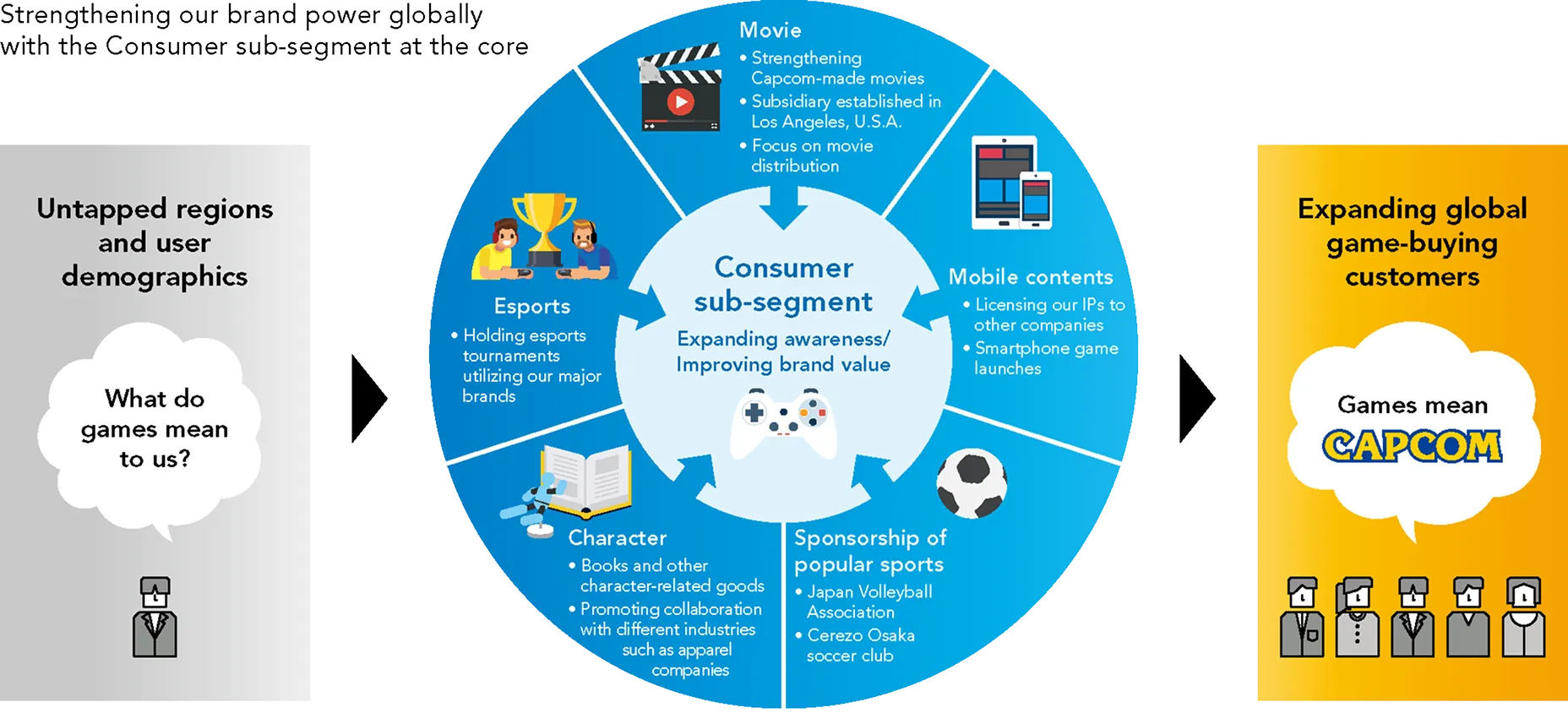
Video content that conveys the world of a game in a short period of time is a powerful tool for increasing Capcom’s brand recognition among people who have never played video games or have never played Capcom’s titles. This is evident in the past Hollywood movie adaptations of Resident Evil and other titles.
In addition to utilizing existing movies based on our games, we are also moving forward with the production of a new live-action Street Fighter movie and TV series, as well as several other projects that are under consideration. As an upfront investment to expand game content worldwide, we will aggressively pursue our movie strategy, not only with theatrical releases, but also through video distribution services and other means.
In April 2025, the anime version of Devil May Cry began streaming as a Netflix original series. In conjunction with this, we priced Devil May Cry 5 for 7.99 US dollars, leading to sales of over one million units in a month. While we have held discount sales to coincide with the release of movie content before, the response this time was so large that it really brought home the close affinity between video games and movies.
Capcom has been promoting the digital shift since the mid-2010s. We possess data on the number of users and regional distribution of each title, which we believe will enable efficient promotion through collaboration with streaming and movie production companies, contributing to the business success of both. As such, we will continue actively exploring collaboration possibilities to further enhance synergies.
Increased penetration of the Capcom brand through business deals and sponsorships
In terms of mobile content, Monster Hunter Now, which we have licensed out, launched in September 2023. This title is developed and operated by an external partner with strengths in location information and AR technology. By allowing players to easily enjoy Monster Hunter as a mobile game, we are further increasing brand awareness globally. We will continue to expand our efforts to raise brand awareness by licensing IP to other companies. One such example is Monster Hunter Outlanders, which was announced in 2024.
The Arcade Operations and Amusement Equipments businesses are each expanding their revenues and contributing to the expansion of our game brands in Japan. The Arcade Operations business is a valuable contact point between Capcom and users, including general consumers, and also provides synergies with the Consumer business sub-segment by acting as a physical venue for game demo events and other activities. The Amusement Equipments business is also expanding its user base and functions as a good match between game content and pachislo machines.
Operating profit has reached a new record high in our licensing business thanks to an increase in collaborative products that coincide with the release of new titles and collaborations where Capcom characters appear in other companies’ games. Currently our licensing business is conducted mainly in Japan and the Asian region, but we are moving forward with measures to strengthen the business with global expansion in mind.
In the eSports business, we have been holding the CAPCOM Pro Tour in up to 160 countries and regions since 2014. More recently, the CAРСОМ Pro Tour 2024 featuring Street Fighter 6 was held around the world starting in June 2024. In March 2025, Capcom Cup 11 and Street Fighter League: World Championship 2024 were held for the first time in Japan at the Ryogoku Kokugikan Arena. The event garnered a solid response with a total of 14,000 attendees and over 10 million online views. Further, in summer 2025, the eSports World Cup was held and by building cooperative relationships with each tournament, including the CAPCOM Pro Tour 2025, we will increase awareness of Street Fighter 6 and accelerate its growth in the global market.
In order to encourage more people around the world to become Capcom fans and users, it is essential to further expand and increase penetration of our corporate and content brands. To this end, we are also engaging in social contribution activities for local communities, culture, and technologies. These include sponsorship of the Japan Volleyball Association and the soccer club Cerezo Osaka, which were first announced in May 2022, as well as sponsorship of the Tokyo International Film Festival, an exhibition showcasing our game development process titled Capcom Creation – Moving Hearts Across the Globe, which has been well-received since its start in March 2025, and the exhibition of an interactive attraction titled Monster Hunter Bridge at Expo 2025 Osaka, Kansai, Japan.
Strengthening development capabilities to consistently produce world-class content
At Capcom, we aim to sustain our KPI of 10% or better annual operating profit growth along with our long-term goal of annual software sales of 100 million units. To improve our chance of success, we are working to resolve business challenges, issue by issue. Our efforts are focused on core IP such as the Resident Evil, Monster Hunter, and Street Fighter franchises, and mapping out mainline series entries and sequels, remakes, new IP, and ports of content to the latest hardware. We consistently release two to three major new titles each year, but recognize the need to grow our pipeline going forward.
Capcom owns a wealth of globally popular brands, such as Mega Man, Devil May Cry, and Ace Attorney. We aim to expand our user base and improve our performance through new releases, remakes, and ports of titles in these series to new hardware. By enhancing brand power and cultivating loyal fan bases, we will grow these into core IPs.
The people developing this content are our world-class in-house creators. For the past three years, we have made strengthening our human capital a management priority, and to this end, have been training and recruiting personnel to expand our development structure. Previously, we consolidated our game development in Osaka to promote efficiency, however, to further strengthen its structure, we are currently constructing a new development facility next to our head office, slated for completion in 2027. We have also acquired nearby land, with future expansion in mind. In addition, RE ENGINE, which supports our development capabilities, was developed in-house and is continually updated to keep up with new technologies and improve work efficiency.
The game business is likely to change even further in the future with the emergence of new technologies such as Al. We were quick to provide support for VR and cross-play, and we continue to push forward with our multi-platform strategy, such as by releasing titles for the new Nintendo Switch 2 on the first day of its release in June 2025, and will continue to explore new fields while conducting technical verification. The key is to use new technologies to provide users with a new gaming experience. Even cutting-edge innovations are meaningless if the game is not interesting.
Finally, I would like to emphasize that even if the form of our business changes, our top priority will remain refining our world-class content. If our salespeople are properly communicating this, then consumers will always choose our products, even if the platforms or services change. Conversely, if our content or services are deficient, even if we are able to ride the transient wave of a trend, growth will not be sustainable. We are convinced of this based on our experience standing at the forefront of the industry.
Medium- to Long-Term Growth Strategy
- The COO’s Discussion of Growth Strategies
- Market Analysis
- CHO & CFO discussion on Capcom’s HR and financial strategies
- Financial Highlights